






20 août 2026
Florence
When it comes to planning a travel itinerary in Florence, it is not easy to try to identify which monument -among hundreds of alternatives - deserves a priority visit.
Here is the second part of our journey through the artistic and museum excellences of Florence.
Basilica of San Miniato
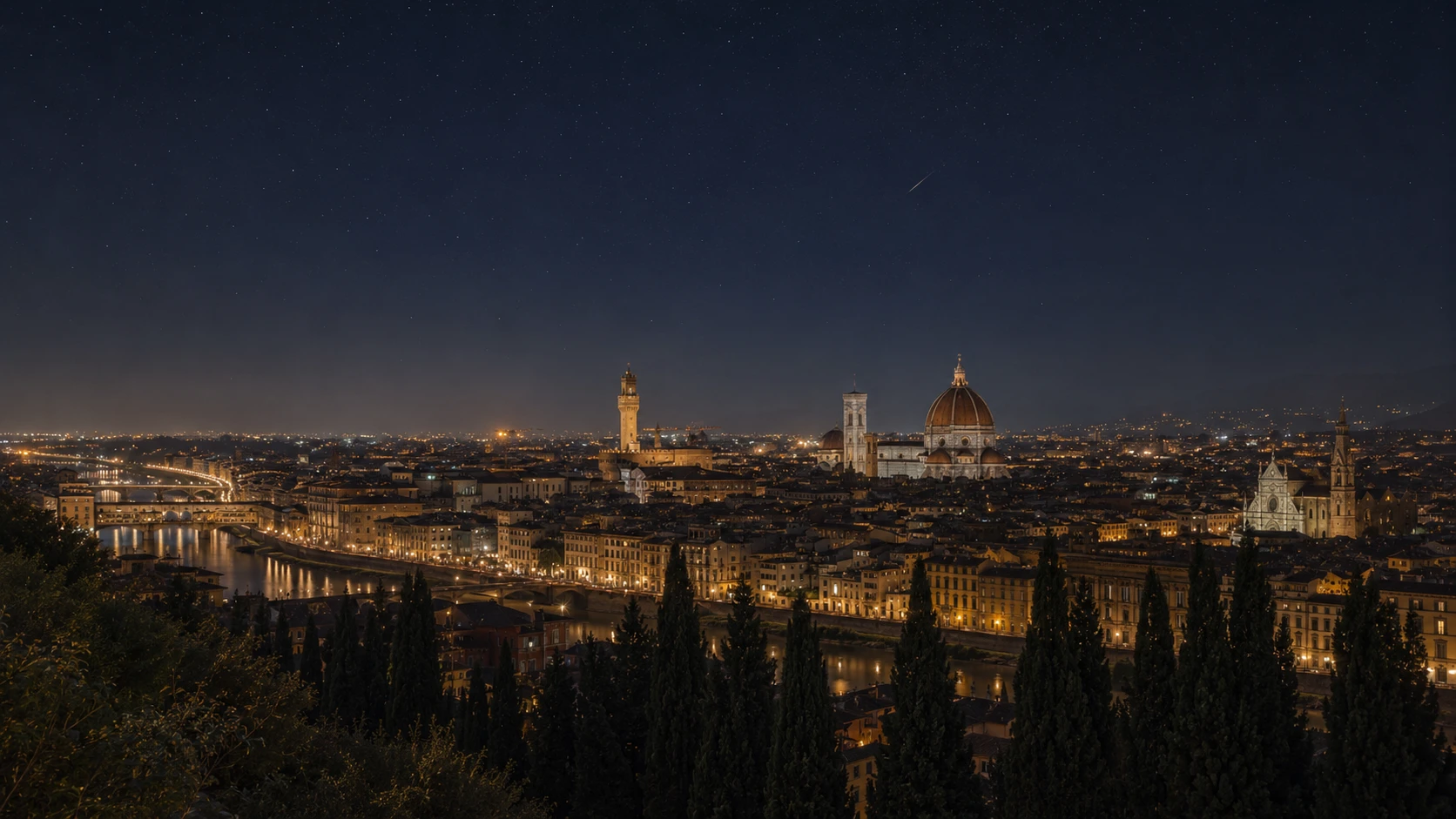
The Basilica of San Miniato is one of the most appreciated religious buildings in Florence: in Florentine Romanesque style, it is located in a privileged position from which to enjoy a wonderful view of the city.
The Latin words Haec est Porta Coeli, meaning "This is the Gate of Heaven," are engraved on a marble scroll ornament on the threshold of the Holy Door of the church of San Miniato al Monte. And as you pass through the turquoise-painted doors and enter the spectacular church itself, it is hard not to feel inspired by this heavenly interior. With its tall marble columns, geometrically patterned arches and gold-leaf decorated dome, the church is an excellent example of Florentine Romanesque reaching its full maturity. A marvel of faith, beauty and history, San Miniato al Monte has been described as one of the most beautiful Romanesque structures in Tuscany and attracts countless travelers to admire its impressive architecture.
The sparkling gold of the apse illuminates the basilica and its surroundings as it did centuries ago, creating a divine atmosphere within the church walls. With its unparalleled beauty and commanding position over the city, San Miniato al Monte truly serves as a decorative crown on the architectural glory of Florence.
Museum of San Marco
The Museo di San Marco, located in the Florentine square of the same name, houses the world's largest collection of Beato Angelico's works, and more. A must-see museum space on one's visit to the city, it is open Tuesday through Saturday from 8:15 am to 1:50 pm. On the second and fourth Sundays of the month it is open from 8:15 a.m. to 1:50 p.m., and on the first and third Mondays of the month it is open from 8:15 a.m. to 1:50 p.m.
The convent of San Marco is an architectural masterpiece built by Michelozzo at the behest of Cosimo de' Medici, and was the home of Fra Girolamo Savonarola, who made it his headquarters. It was declared a museum of national importance in 1869.
The beautiful spaces that now house the museum are located next to St. Mark's Church and rooms adjacent to the cloister, which is still used as a monastery.
The San Marco Museum houses some of Florence's most interesting collections and works, including the collections moved here from the Museum of Ancient Florence after it was demolished in the 19th century.
A visit to St. Mark's includes the beautiful cells, the Cloister of St. Anthony, the Last Supper Room, the Refectory, and the Chapter House.
True jewels of the San Marco Museum are the works of art by Fra Angelico, including the world-famous Annunciation, a masterpiece of Renaissance painting.
The Hospice Hall is entirely dedicated to Fra Angelico and features the Deposition of Christ, the Triptych of St. Peter Martyr, the Annalena Altarpiece, the Last Judgment (1431), the St. Mark's Altarpiece, the Madonna and Child, and the Tabernacle of the Linnaeoli.
The second floor houses the ancient cells of the monks, decorated with frescoes of great fame and beauty. Created between 1438 and 1446, they testify to the most mature phase of Beato Angelico's art and are an example of absolute modernity and refinement, never before realized in a monastery.
Completing the San Marco Museum's rich collection is its fabulous Library (1437-1444), which houses priceless manuscripts that belonged to the Medici family and personalities such as Pico della Mirandola and Agnolo Poliziano.
Lorenzo the Magnificent promoted the growth and enrichment of the library, which was one of the main forges of Renaissance culture and houses many volumes of Latin and Greek manuscripts.
The St. Mark's Museum also features a large number of other works of art of inestimable historical and artistic value, such as Ghirlandaio's Last Supper, Ridolfo del Ghirlandaio's Madonna of the Girdle, Paolo Uccello's Madonna and Child, the famous portrait of Girolamo Savonarola, and several glazed terracottas by the Della Robbia School.
St. Mark's Church, adjacent to the Museum, is also very fascinating.